Review of Sapiens a Brief History of Humankind
Book Review | Sapiens: A Cursory History of Humankind by Yuval Noah Harari
Every so oftentimes a not-fiction book captures the attention of the reading public to such an extent that it becomes impossible to ignore. Information technology isn't always obvious why. Suddenly you tin can't turn around in your local bookshop without knocking over a full display of them and everyone you lot meet is quoting their favourite fact. Sapiens: A Brief History of Humankind is definitely one of those books. Information technology was published in English in 2014 and has barely been out of the bestseller lists since.
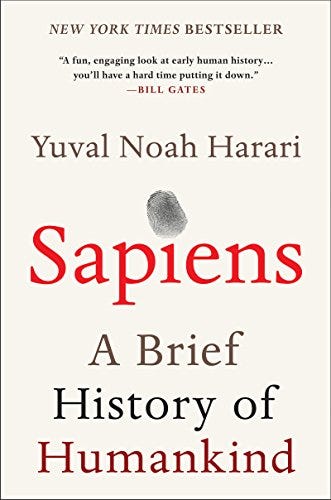
In this instance information technology isn't actually that hard to understand why. Sapiens takes as information technology discipline the thing we are nigh interested in — ourselves. And it looks to respond the most primal of questions — how did all this happen? It approaches that ballsy chore in an engaging, digestible, and oftentimes provocative romp through our cursory sojourn on Planet Earth.
At its cadre this is not a happy account of anything you could meaningfully call success. As Harari's says:
"the Sapiens authorities on world has so far produced trivial that we tin can be proud of… [t]ime and fourth dimension again massive increases in human power did not necessarily improve the well-beingness of individual Sapiens, and commonly acquired immense misery to other animals".
Non a corking review for a species that "stands on the verge of becoming a god".
Harari'southward account of how this came to laissez passer is dissever into four sections. He starts with the Cognitive Revolution, in which the final piece of the evolutionary puzzle fell into identify. The Homo Sapiens that emerged from this are, biologically speaking, identical to united states. I found it humbling to remember that. Despite the manifold differences in how we alive those people felt yet things we do. They loved, they dreamed, they feared, they fought, and they hoped just as we do. But they did and so in a globe we would struggle to even begin to recognise.
The almost profound changes in that world were sparked past the subject of the 2nd section: the Agronomical Revolution. For most this marks the start of our story. The betoken at which we mastered Eden and put it to productive use. Harari describes it as the biggest error we've e'er made. Great for humanity's collective domination but utterly miserable for almost all the individuals involved. This dichotomy is something Harari keeps coming back to. Proliferation of a species should not be deemed as synonymous with success. More is not better.
He comes back to this at the end of the book, exploring what it means to be happy. As he points out, there is nigh no way of knowing whether our cushy 21st century lives brand us objectively happier than our ancestors. He concludes that objectivity is actually entirely the wrong mode to recollect most that problem: "[happiness] depends on the correlation between objective status and subjective expectations." More profoundly even so "if you accept a why to alive, you can bear nigh any how."
The rather spooky conclusion is that given our rising expectations we are probably non notably happier than those who came earlier us.
After exploring how we transitioned from a nomadic to settled species, the book then moves on to examining humanity'southward inexorable coalescence into a single amorphous system. Harari lightly traces this through various historical examples but at all times focusing on the meta-narrative. He argues, persuasively, that our success in achieving this unity is ultimately our remarkable ability to create and buy into a multifariousness of "intersubjective myths". Things that be only in the minds of those who believe in them, have no basis in the physical sciences, simply enable cooperation on a mass scale. The three nigh indelible of these have been our economic system, imperial or national states, and faith.
The chapters on the evolution of these interconnected and interdependent systems are probably the section of the book I found most intriguing. To be reminded of the constructed nature of these systems does not to my mind diminish their power. It instead reinforces our remarkable reliance on narrative. To have created such intricate ways to depict the performance of our world to each other, based on nothing more, and aught less, than our commonage imagination is actually a remarkable feat. Simply this section as well reminded me how astonishingly recently the world became a single entity. Merchandise, travel and the substitution of ideas accept existed for thousands of years. But a genuinely global population has existed for no more than a couple of centuries. The integration of the last remnants of the isolated worlds into our global community was recent enough that we know the names of those who lived through it. I institute it impossible to envisage how information technology must take felt to have some other world arrive on your beach after numberless generations of your world being unquestionably the whole world. Nosotros will never know that feeling once more.
Finally, Harari brings u.s. up to appointment past examining the Scientific Revolution. This i has barely started. Forged in Europe in the center of the final millenium, and so violently exported around the world, this revolution marked a profound break with how humans saw themselves. Harari attributes this shift to a disarmingly simple cause. Nosotros understood nosotros are ignorant. As shortly every bit those scales fell the thirst for new knowledge was unquenchable. So unquenchable in fact that it harnessed itself to the twin systems of capitalism and imperialism to envelop the earth. The reason that this revolution is unfinished is largely a function of fourth dimension. The other shifts that Harari described play out over 1,000 years or maybe 10,000s of years. Scientific advances that allow us to move across the biological constraints placed on us by evolution will, in Harari'southward telling, be the thing that shape the next phase of the human feel. Shape u.s.a. and so profoundly in fact that it might be hard to even imagine the consequences.
Past the time I'd finished the book it wasn't entirely articulate to me whether the "brief" in the championship is meant in earnest. For nearly readers 443 pages of closely typed prose isn't brief. For most people 100,000 years isn't that cursory either.
I ended upwards realising that the "cursory" is best interpreted as an pedagogy on how Harari intends to guide his reader through fourth dimension. The book began life as a series of lectures at the Hebrew University in Jerusalem and y'all can still see the vestiges of that arroyo. The sections are short and pacey, the conclusions are business firm and provocative, there is a slightly questionable smattering of pictures.
There is a lot to be said for this approach. Information technology is certainly preferable to a turgid review of academic literature. Information technology is mayhap the only guaranteed way to ensure the reader keeps going. But it does have drawbacks. I was left wanting to know more about almost everything. I wish Harari had given himself more fourth dimension to explore some of the most interesting transitions in our collective history:
How is it that linguistic communication became and so integral to our success equally a species?
Why did Homo Sapiens master exploration, adaption and exploitation, in a way that no other species was able to?
Why has everything changed and so dramatically in the last 200 years after millenia of inertia?
Each of these questions is raised just I'm not sure that I'g left with a satisfying answer. Perhaps we don't know. Perhaps I demand to seek my answers elsewhere. I'd dear to know. I would too accept loved Harari to spend some more time on the cost our planet has paid for this ascendency. There are glimpses of this. The fact that the collective weight of humans and domesticated animals in the earth today is 10x the weight of all the big wild animals is amazing. There are 1.5 billions cows and just 80,000 giraffes (that is twenty,000 cows per giraffe!). But despite this I'k not sure there is a total recognition of the fact David Wallace-Wells has made so forcefully; everything that nosotros have e'er known, or ever called civilisation, has existed with a set of climatological parameters that no longer be. It is sobering to say the least.
There is too a danger that Hariri's brevity becomes glibness. Every bit human development begins to accelerate after the agricultural revolution (c10,000 years ago) the reader is increasingly left with the sense we are skating across the surface. Much of the academic response to this book has been dismissive or derogatory. That might be wounded pride or unattractive envy, but a lot of it is probably likewise fair. There are points at which it feels like the volume's provocations are grounded more in a want to be provocative, rather than a deep engagement with the historiography.
This sense of "glibness" was brought into sharper relief when I compared this book with the only other book I've read of comparable latitude: Steven Pinker's Better Angels of our Nature. I should preface this by saying that Pinker'south volume is probably the best piece of non-fiction I've ever read. The comparison does not do Sapiens whatever favours. By focusing on a specific theme, the inexorable refuse of violence in man gild, Pinker offers the reader a tour-de-strength in intellectual argumentation. He ranges from complex statistical analysis, to deep historical inquiry, to pithily explained psychology, and to the physical structures of the rage systems in the brain. At every point you experience similar you are in the hands of an expert without needing to be an proficient. He is assured and astonishingly informative at the same fourth dimension. Pinker also has graphs not pictures. Lots of graphs. Graphs do not maketh a adept book but they help give it weight. I felt in places Harari could take done with a dainty chart or two.
None of this is to say Sapiens is not worth your time. It is. It taught me a lot I didn't know and gave me a new way to think nigh things I thought I did. I would encourage anyone who hasn't already to choice information technology up. I'1000 definitely looking forward to Harari'due south other work.
Annotation: This is an edited version of my (sort of) weekly newsletter 5 Things for Friday. If yous're curious please email me ( hither ) and I'll add y'all to the mailing list
Source: https://medium.com/@chris_jack_hook/book-review-sapiens-a-brief-history-of-humankind-by-yuval-noah-harari-fe64816e59cc

Postar um comentário for "Review of Sapiens a Brief History of Humankind"